
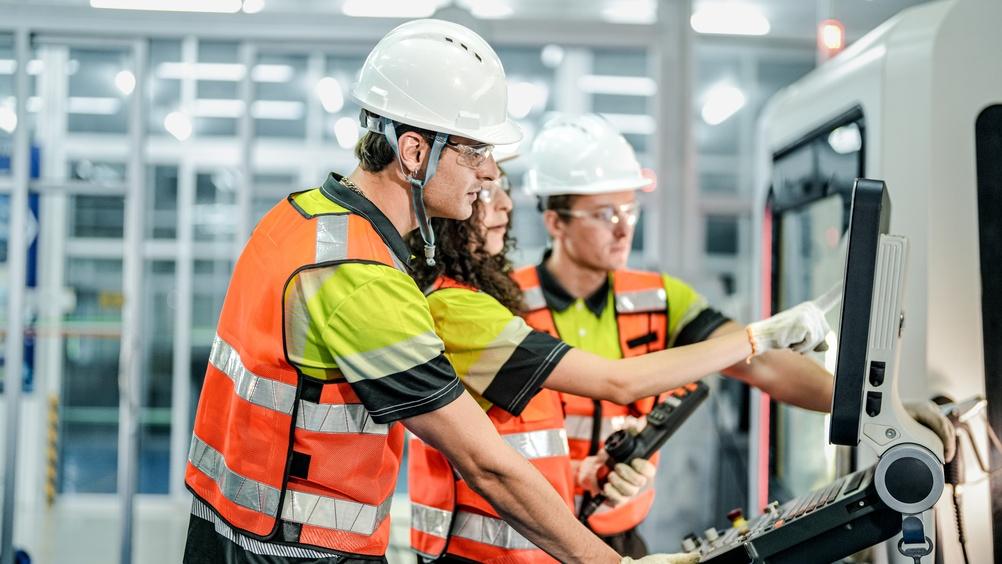
Industrial productivity depends on more than advanced machinery and efficient production lines. The people operating, maintaining and managing equipment play an equally important role in determining how well a manufacturing facility performs. Even the most sophisticated tools cannot deliver consistent results if employees lack the knowledge required to use them correctly.
Manufacturers face increasing pressure to improve quality, reduce downtime and adapt to technological developments. At the same time, many industries experience difficulties recruiting skilled personnel and retaining experienced employees. These challenges make continuous professional training an essential part of long-term operational planning.
Technical training helps bridge the gap between equipment capabilities and practical performance. By improving employees’ understanding of assembly processes, tightening techniques, quality requirements and industrial technology, companies can create more reliable production environments.
Effective training also supports workplace safety and employee confidence. When operators understand why a procedure must be followed, rather than simply memorizing individual steps, they are better prepared to recognize unusual conditions and respond appropriately.
For manufacturers seeking sustainable improvements, investing in workforce competence can be just as important as investing in new equipment. A structured approach to training provides opportunities to strengthen operational consistency, improve collaboration and prepare employees for future changes.
Industrial training builds the foundation for better performance
Modern manufacturing involves a wide range of technical processes, each requiring specific knowledge and practical skills. Assembly operations, for example, may involve controlled tightening, specialized equipment and detailed quality requirements. Employees must understand both the tools they use and the consequences of incorrect operation.
Companies interested in developing these capabilities can find relevant training information through Atlas Copco, and this link will take you further into its Master Class training program. The program focuses on improving manufacturing competence, with courses covering tightening techniques and other aspects of industrial operations.
Technical training is particularly valuable when employees work with equipment that requires precise settings or carefully defined procedures. A tightening tool may be capable of delivering accurate results, but its performance depends on correct configuration, suitable application and proper handling.
Operators who understand the fundamentals of threaded fastening are better equipped to recognize why different joints require different tightening strategies. They can also appreciate the importance of factors such as friction, lubrication, fastener geometry and material properties.
This understanding supports more consistent assembly quality. Instead of treating every tightening operation as an identical task, employees learn to recognize the technical requirements of the specific application.
Training also helps establish common working methods. In facilities where several teams or shifts use the same equipment, differences in experience and individual habits can create unnecessary process variation.
A structured training program provides a shared foundation for how tasks should be performed, how equipment should be checked and when unexpected results should be reported.
For new employees, this can make the transition into production work more manageable. Experienced personnel may also benefit from refreshing their knowledge or learning about technologies introduced since their initial training.
The greatest value comes when technical education is connected directly to everyday production challenges. Employees should be able to apply what they learn to the equipment, processes and quality requirements they encounter at work.
Understanding tightening techniques and assembly quality
Threaded fastening is one of the most common operations in industrial manufacturing. Bolts and screws are used to secure components in vehicles, machinery, electronic equipment and countless other products.
Although tightening a fastener may appear straightforward, the underlying mechanics can be complex. The objective is usually to create sufficient clamping force to hold the assembled components together under expected operating conditions.
Torque is commonly used as a control parameter, but applied torque does not translate directly into a fixed clamping force. Friction in the threads and beneath the fastener’s bearing surface influences how much of the applied energy contributes to bolt elongation.
As a result, two fasteners tightened to the same torque can develop different preload values when their friction conditions differ.
Understanding this relationship is important for engineers, quality specialists and operators working with controlled tightening processes.
Training in tightening techniques can explain how joint design, material properties and tightening strategies influence assembly results. It can also demonstrate why calibration and verification are necessary for maintaining reliable tool performance.
For example, a tool that produces consistent torque measurements may still be unsuitable for a particular joint if the selected tightening strategy does not account for its characteristics.
More advanced assembly systems can monitor torque and angle during fastening. These measurements provide additional information about the tightening process and can help identify certain abnormal conditions.
However, interpreting the results requires technical knowledge. A successful tightening indication should be understood within the context of the validated process rather than treated as an absolute guarantee of joint integrity.
Practical exercises can make these concepts easier to understand. Demonstrations using different fasteners, joint conditions and tightening methods allow participants to observe how changes influence the results.
This combination of theoretical knowledge and hands-on experience helps employees connect engineering principles with real production situations.
When personnel understand the reasons behind tightening specifications, they are better positioned to follow procedures consistently and communicate potential problems before they lead to defects.
Training supports safety, efficiency and reduced downtime
Workplace safety is closely connected to technical competence. Industrial tools can generate substantial forces, and incorrect handling may expose operators to unnecessary risks.
High-torque tightening equipment, for example, produces reaction forces that must be managed appropriately. Employees need to understand correct tool positioning, suitable reaction points and the hazards associated with moving components.
Pneumatic and hydraulic systems introduce additional considerations involving pressure, hoses, connections and maintenance procedures. Electrical equipment requires attention to cables, batteries and relevant safety instructions.
Training helps employees recognize these hazards and understand the precautions required for their particular tasks.
It can also improve equipment care. Operators who know how tools should function are more likely to notice unusual noises, unexpected behavior or changes in performance.
Early identification of potential problems creates opportunities for maintenance teams to investigate equipment before a failure interrupts production.
However, training alone cannot eliminate downtime. Reliable operations also depend on preventive maintenance, spare parts availability, appropriate equipment selection and effective production planning.
The role of training is to help employees contribute to these systems by using equipment correctly and reporting relevant information.
Operational efficiency can also improve when personnel understand the complete assembly process. Unnecessary handling, incorrect tool settings and repeated adjustments can increase cycle times without adding value.
Employees who are familiar with standardized procedures can perform tasks more confidently and recognize when an operation is not progressing as expected.
This is particularly important during production changes. Introducing a new tool or modifying an assembly sequence can create uncertainty if employees have not received appropriate instruction.
Training before implementation helps reduce this uncertainty and allows teams to become familiar with the equipment under controlled conditions.
A structured learning process can therefore support smoother transitions while reducing the risk of avoidable errors during the early stages of a new operation.
Developing workforce competence for changing technologies
Industrial manufacturing is increasingly influenced by automation, digital connectivity and advanced process monitoring. These technologies can improve consistency and provide valuable production information, but they also change the skills required in the workplace.
Traditional assembly tasks may now involve programmable tightening tools, digital operator guidance and software that records individual operations.
Employees must understand not only how to operate the equipment but also how to interpret the information it provides.
For example, a connected tightening system may display whether a fastening operation has met specified parameters. When an operation is rejected, the operator needs to understand the appropriate response rather than repeatedly attempting the same task without investigation.
Maintenance personnel may require additional knowledge about controllers, communication systems and diagnostic procedures.
Production engineers and quality specialists may need to interpret process data and determine whether recurring deviations indicate equipment problems or changes in joint behavior.
Training requirements therefore vary between professional roles. A course designed for assembly operators may focus on correct handling and process awareness, while more advanced instruction may explore technical principles and troubleshooting.
Atlas Copco’s Master Class approach includes different levels of tightening technique training, with basic courses and more advanced options depending on the market. Classroom instruction can also be adapted to the needs of particular participant groups.
This flexibility is important because employees enter training with different levels of experience. A newly recruited operator may need an introduction to basic principles, while an experienced engineer may benefit from deeper technical discussion.
Combining theoretical instruction with practical exercises can help accommodate these differences.
Digital learning may also play a role in industrial education, particularly for introducing concepts or refreshing existing knowledge. However, practical training remains important when employees must develop physical skills and learn to handle equipment safely.
As technology continues to evolve, training should be treated as an ongoing activity rather than a one-time requirement.
Regular competence development helps organizations maintain relevant skills and reduces dependence on a small number of highly experienced employees.
Creating a long-term strategy for continuous improvement
A successful industrial training initiative begins with understanding the organization’s actual needs. Providing courses without identifying specific competence gaps may generate limited practical benefits.
Manufacturers should first examine the challenges affecting their operations. These may include inconsistent assembly quality, frequent tool-related interruptions, lengthy onboarding periods or difficulties adapting to new production technologies.
Once these challenges have been identified, training objectives can be defined more clearly.
For example, a facility experiencing repeated tightening errors may benefit from improving employees’ understanding of joint behavior, tool settings and process verification.
A company introducing connected assembly equipment may need instruction covering digital interfaces, error messages and the handling of recorded production data.
Training should also be coordinated with existing quality and maintenance procedures. Employees need to understand how their responsibilities fit into the broader production system.
Supervisors and technical specialists can support this process by reinforcing the lessons learned during everyday work.
The effectiveness of training should be evaluated through relevant operational indicators. Depending on the objectives, these may include defect rates, rework, equipment-related downtime or the time required for new employees to become competent.
Such measurements must be interpreted carefully because production performance is influenced by many factors beyond employee knowledge.
Feedback from participants is equally valuable. Employees can identify which parts of a course were useful and where additional practical guidance may be required.
Organizations should also consider how knowledge is maintained when experienced personnel leave or move into new roles. Documented procedures, mentoring and periodic refresher training can help preserve important operational competence.
Continuous improvement depends on combining knowledge with practical action. Training provides employees with the understanding needed to recognize problems, but management must also create opportunities to implement appropriate changes.
When workforce development is integrated with equipment maintenance, process optimization and quality management, it becomes part of a broader operational strategy.
The objective is not simply to complete a certain number of training sessions. It is to establish a workforce capable of performing tasks consistently, adapting to new technologies and contributing to reliable production.
Industrial organizations that invest in relevant technical knowledge can strengthen their ability to respond to changing requirements. By connecting structured training with everyday manufacturing challenges, they create better conditions for safe operations, consistent quality and long-term productivity.
